
Need help getting started with buying cryptocurrency? Crypto exchanges are your entry point into this rapidly growing digital world. Just picture a market where people can buy, sell, and trade Bitcoin, Ethereum, and other digital currencies. Crypto exchanges don’t have a central authority like standard stock exchanges do. This article explores what is crypto exchanges, including the types and how they work.
What Is Cryptocurrency Exchange?
Crypto exchanges serve as entry points for those interested in purchasing Bitcoin or other digital currencies. You can buy, sell, and trade coins like Ethereum and Tether on these websites, which work like stock markets. They are easy for both new and experienced investors to use because they can be accessed through mobile apps or computers.

Some exchanges offer more complicated features than just basic crypto trading, such as futures contracts or margin trading. For these services, they charge fees based on the number of transactions or the type of trade. Before exchanges, the only ways to get crypto were through mining or specific online groups.
There are now hundreds of companies that offer different currencies and charge different fees and security measures. Fees have gone down in standard markets, but trading in cryptocurrencies usually costs more. The best exchange will make it easy to trade, have low fees, and offer strong protection to keep your digital assets safe.
How Do Crypto Exchanges Work?
Crypto exchanges facilitate transactions between buyers and sellers by matching them. When someone wants to buy or sell cryptocurrency, the exchange looks for another person who has placed the same order. After that, the trade is carried out, and the digital asset is moved from one wallet to another.
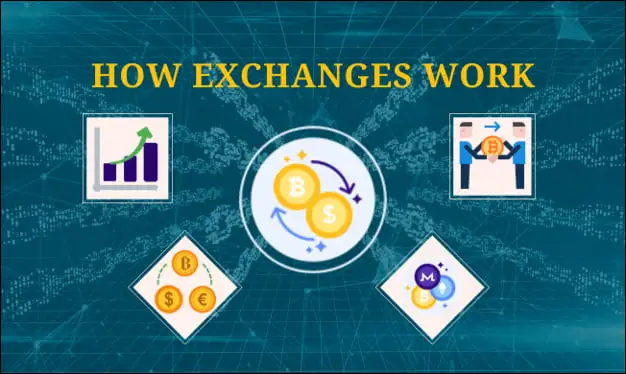
Exchanges may charge fees for these services so that they can make money from the trades that happen on their site.
Crypto exchanges also have many tools and features that can help users make smart buying choices. Some of these are market research, charts, and different types of orders like market orders, limit orders, and stop-loss orders. To trade cryptocurrencies effectively, you need to know how to use these tools.
Types of Cryptocurrency Exchanges
These are the most well-known types of cryptocurrency exchanges:
Centralized Exchanges (CEX)
Centralized crypto exchanges (CEXs) are like stock exchanges for digital assets; they act as middlemen in crypto trade. Platforms like Binance and Coinbase are very popular. Cryptocurrency investors can buy and sell at spot prices, which are the current prices, or they can set limit orders that go off at a certain price. A method called an “order book” keeps track of buy and sell orders with respect to price at CEXs.
The matching engine on the exchange then matches buyers and sellers according to the required amount and the best price. Based on supply and demand in comparison to other currencies or fiat money, this system determines the price of crypto. Additionally, CEXs decide which digital assets can be sold, which can be helpful because they may not allow less trustworthy ones.
| Advantages | Disadvantages |
| Great liquidity. | Easier for hackers as CEX stores valuable user data across centralized servers. |
| Recovery of the user’s fund is possible. | Have been charged with manipulating trading volume in the past. |
| Able to handle transactions faster. |
Decentralized Exchanges (DEX)
You could also use a decentralized exchange (DEX), such as Uniswap or dYdX. DEXs connect customers and sellers directly, without a third party, unlike centralized exchanges. For safe peer-to-peer transfers, DEXs use smart contracts and automated blockchain code. DEXs usually give you more privacy and lower fees. Still, you need to know more about them because there isn’t a central authority that handles conflicts.
| Advantages | Disadvantages |
| Full custody of their funds. | Low liquidity. |
| More security and privacy. | |
| Distributed hosting reduces the risk of cyberattacks. |
Hybrid Exchanges
Hybrid exchanges provide a combination of centralized and decentralized functionality for their users. Like centralized exchanges, they quickly match orders so that trade goes smoothly. Nevertheless, hybrid exchanges, in contrast to DEXs, directly store users’ crypto assets in their wallets. Users still have power and can freely withdraw their money. Hybrid exchanges are like DEXs in that they let users control assets and match orders quickly, as centralized systems do.
| Advantages | Disadvantages |
| Provides the strengths of both DEX and CEX. | Relatively a very new concept. |
| Provides a high level of privacy. | Do not have much volume to date. |
| Closed ecosystem | |
| Protection of privacy while communicating with shareholders. |
How to Choose a Cryptocurrency Exchange
These are the most important things that every investor should look for in a crypto exchange:
- Cryptocurrency regulations vary by country. So, before you pick a swap, make sure it works where you are. Some platforms have different websites for different parts of the world (for example, exchange.com vs. exchange.us).
- Are you new to crypto? Start with a trade that is easy to understand and use. Some platforms have simple interfaces or styles that are good for beginners so that charts and features don’t get too confusing. Look for choices that are clear and easy to understand.
- Select an exchange with a high level of liquidity to ensure seamless transactions. In other words, a lot of buyers and sellers make it easy for you to buy and sell crypto whenever you want. When markets are unstable, low liquidity can make it hard to find trade partners and make price swings worse.
- Not all crypto coins are offered on all exchanges. It’s easy to find common coins like Bitcoin and Ethereum, but it might be harder to find rarer ones. Please make a list of the cryptocurrencies you want to buy, and then see which platforms have them.
- It’s important to choose a cryptocurrency exchange with a good track record for security. Go for exchanges that have been around form a maximum period of time. Exchanges that have been around for a while are more likely to have strong security measures. When looking at an exchange’s security, you should check to see if it uses “cold storage” to keep most of its users’ money offline and out of reach of hackers. Also, find out if they use multi-signature wallets. These add an extra layer of security by requiring multiple approvals to access funds.
- Online cryptocurrency exchanges have fees, so choose one with cheap fees! 7. Select an exchange with great customer service! Some even give deals to people who hold their unique tokens. People who are new to investing often have questions, and errors can happen. Crypto moves quickly, so it can cost a lot to wait days for help. Look for a swap that has a good name for having quick and helpful customer service.
- The majority of exchanges offer spot trading for cryptocurrency. Some, though, are derivatives markets where people trade contracts based on the price of crypto in the future instead of the coin itself. This can be risky because it’s sometimes okay to use leverage, which means borrowing money. This makes gains and losses bigger.
- Take withdrawal limitations into account! Even if you plan to keep it for a long time, some exchanges put limits on how much you can take each day, like $25,000. Pick an exchange that lets you take the amount of money you need.
- Select a transparent exchange. Find clear information about fees, transaction times, safety, and where the transactions can happen. Stay away from shady deals!
Popular Crypto Exchanges in the Crypto Market
Due to their dependability, features, and ease of use, a number of cryptocurrency exchanges have become very popular. Selecting the right market is important for both new and seasoned traders. The following are a few of the most popular and widely recognized cryptocurrency exchanges:
| Exchange | Features |
| Coinbase | Coinbase is a highly popular and user-friendly exchange, ideal for beginners. It offers strong security features, a wide range of supported cryptocurrencies, and a simple interface, along with Coinbase Pro for more advanced trading options with lower fees. |
| Binance | Binance is one of the largest cryptocurrency exchanges globally, known for its extensive range of cryptos and advanced trading features. It caters to experienced traders with high liquidity, margin trading, and a robust educational platform through Binance Academy. Binance had a trading volume of $3.3 trillion between January 1 and November 23 of 2023. |
| Kraken | Kraken is renowned for its security and regulatory compliance, making it a trusted choice for both beginners and professionals. It offers a wide range of cryptocurrencies, advanced trading options, and lower fees with Kraken Pro. |
| Gemini | Gemini, founded by the Winklevoss twins, emphasizes security and regulatory compliance. It is user-friendly, supports a variety of cryptocurrencies, and offers interest-earning options through Gemini Earn. |
| Bitfinex | Bitfinex is known for its advanced trading features and high liquidity, catering primarily to professional traders. It provides detailed charting tools, margin trading, and a robust API for algorithmic trading. |
| OKX | OKX is a major global exchange providing a variety of trading options and financial services. It offers extensive cryptocurrency support, advanced trading features, and strong security with competitive fees. |
| KuCoin | KuCoin is a rapidly growing exchange known for its wide range of supported cryptocurrencies and innovative features. It provides a user-friendly interface, competitive fees, and additional services like staking and lending. |
| Bybit | Bybit specializes in cryptocurrency derivatives, focusing on futures and perpetual contracts. It offers a seamless trading experience with high liquidity, advanced charting tools, and robust security measures. |
Conclusion
Crypto markets are very important to the world of digital currencies because they let people buy, sell, and trade crypto. Anyone who wants to get into the crypto market needs to know how these trades work, including the different types and how they work.
To find the best exchange, you need to look at its security measures, fees, user experience, list of cryptocurrencies, liquidity, image, and compliance with regulations. If traders and investors carefully think about these things, they can choose an exchange that fits their needs and makes dealing safe and easy.
FAQs
What is crypto exchange?
Digital marketplaces called crypto exchanges let people buy, sell, and trade different cryptocurrencies. They work like current markets made possible by blockchain technology.
How to choose an exchange to buy crypto?
Selecting a cryptocurrency exchange is similar to investigating a new market: take into account elements like user interface ease, costs, supported payment methods, security protocols, reputation, available currencies, and compliance with regional laws.
How many cryptocurrency exchanges are there?
There are many cryptocurrency markets around the world. A few instances of cryptocurrency exchanges are Gate.io, Coinbase, OKX, Bybit, Upbit, Kraken, and Binance. CoinMarketCap lets you keep an eye on the most well-known ones.