
You may be familiar with the phrase “cryptocurrency” but what does it actually mean? Simply put, Cryptocurrency is digital or virtual money that is protected by cryptography. Cryptocurrencies depend on decentralized networks built on a technology known as blockchain, in contrast to conventional currencies that governments and central banks issue. In this guide we will explain what is cryptocurrency and how does it work its types and how they are created and many other factors.

What Is Cryptocurrency?
Cryptocurrency is a type of digital money that can only be used online. It’s not managed by a central bank like regular money is. It is instead based on a system called blockchain, which a group of users runs. In other words, you don’t need a bank or broker to use it.
Key Features of Cryptocurrency
- Decentralized: Cryptocurrencies are not controlled by a single group, like a bank. Blockchain technology is what makes them work instead.
- Secure: Transactions using cryptography are safe and practically impossible to forge.
- Transparent: All transactions are documented on an open ledger that is accessible by anybody.
- Global: Cryptocurrencies can be used to make deals anywhere in the world without any problems.
A Brief History of Cryptocurrency
Bitcoin was the first Cryptocurrency and an attempt to replace central banks and government-issued currency.
Important Steps:
- 2009: The cryptocurrency era began when the Genesis Block, the first block of Bitcoin, was mined.
- 2010: The first-ever real-world Bitcoin transaction took place when a programmer paid 10,000 BTC for two pizzas.
- 2015: Ethereum came out, adding smart contracts and making it possible for more uses than just trades.
- 2020–2021: Companies like Tesla and PayPal started to accept Bitcoin, which brought Cryptocurrency to a wider audience. At the same time, NFTs (non-fungible tokens) took the world by storm.
How Cryptocurrencies Are Created?
When Cryptocurrency is created, the process is referred to as mining. Validation is necessary for cryptocurrency transactions, and mining generates new Cryptocurrency. Mining is the process of adding data to the blockchain using special hardware and software.
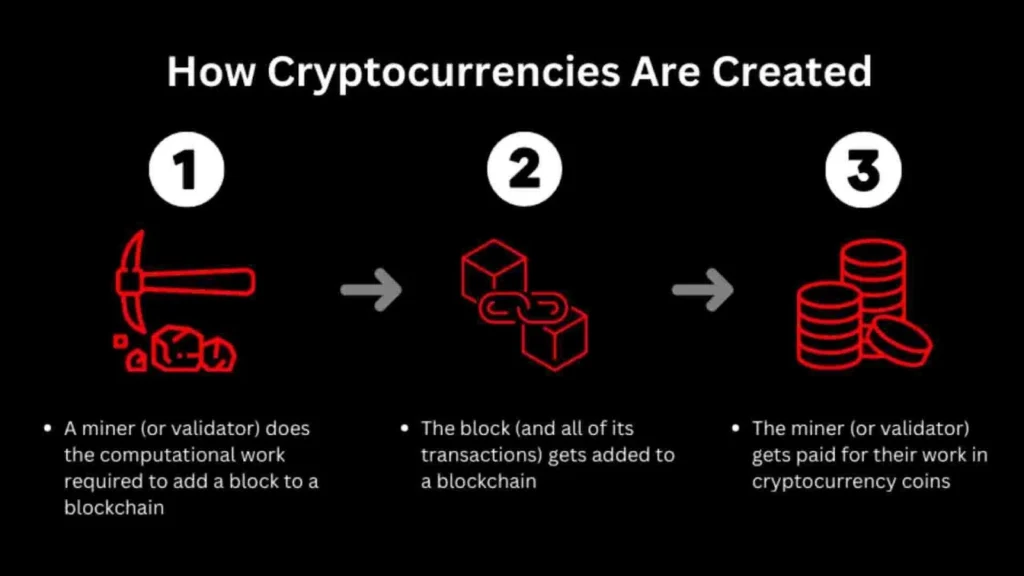
Mining isn’t the only source of Cryptocurrency. To give you an example, crypto that you can’t spend isn’t generated. Developers instead use a hard fork to generate the new currency. In the blockchain, a hard fork produces a new chain. When you split in two, one goes down the new road and the other down the old one. Cryptocurrency that isn’t mineable is usually utilized for investments as opposed to buying.
How Does Cryptocurrency Work?
Step 1: Initiating a Transaction
As the initial step, you enter the amount you want to give and the recipient’s public address into your digital wallet, also known as a D-Wallet. This address is like an email address, but it’s only used for Cryptocurrency. After you check the information, your request is sent out to the network.
Step 2: Broadcasting the Transaction to the Network
A network of computers, called nodes, receives your transaction. The nodes work in a decentralized system, which means that a single financial company does not run the network. Transparency is maintained, and banks are not needed as intermediaries.
Step 3: Verification of Transactions
All the nodes in the network use cryptographic methods to check transactions. They verify whether or not:
- You are the rightful owner of the digital asset you are attempting to send.
- The money has not already been used.
- The blockchain is a log that keeps track of all transactions, which makes this possible.
Step 4: Making Blocks Out of Transactions
After being checked, your transaction is added to others in a block. This block, which is like a page in the blockchain, has information about all the most recent trades.
Step 5: Mining and Securing the Block
Miners are computers that use complicated math problems to make sure the block is real. Mining is the procedure that verifies that the transactions contained within a block are unchangeable. The miners compete to find the solution, and new cryptocurrency tokens are awarded to the first solver.
Step 6: Add the block to the blockchain
The block is added to the blockchain after it has been mined. The blockchain keeps track of all transactions in a safe, unchangeable record. This makes things clear and makes sure that everyone on the network can depend on the info.
Step 7: Completion of the Transaction
Your transfer is finished when the block has been added to the blockchain. The updated balance will be reflected in the recipient’s D-Wallet. This process is very safe because it uses encryption and digital proof to protect the blockchain.
Step 8: Storing Your Cryptocurrency
You keep your cryptocurrencies in your D-Wallet. It is now prepared to be transferred once more, retained as an investment, or used as a payment mechanism. Wallets offer different levels of protection depending on whether they are online, offline, or hardware-based.
Types of Cryptocurrencies
Today, there are thousands of coins, and each one has its features. Let’s look at some of the most well-known and see what makes them unique.
Is Cryptocurrency a Good Investment?
In the past few years, cryptocurrencies have become an established category of asset, drawing buyers from both individual and institutional sources. Whether Cryptocurrency is good or bad relies on your financial goals, how willing you are to take risks, and how well you understand the market.
Potential Benefits
High Potential Returns: The prices of some cryptocurrencies have gone up a lot. People who bought assets like Bitcoin and Ethereum early have made a lot of money.
Diversification: Cryptocurrencies can help diversify an investment strategy because they don’t always closely match up with traditional assets like stocks and bonds.
Innovation and Technology: Investing in cryptocurrencies helps blockchain, which could change many fields, such as healthcare, finance, and the supply chain.
Potential Risks
- Volatility: The markets for cryptocurrencies are very unstable. Prices can change a lot in a short amount of time, causing big gains or losses.
- Uncertainty about regulations: The rules that govern Cryptocurrency are still changing. Laws and rules that change can affect the worth and legality of some digital assets.
- Security Concerns: Cyberattacks, fraud, and hacking are common risks. Understanding cybersecurity and securing D-Wallet is critical.
- Lack of intrinsic value: The value of many cryptocurrencies is based on speculation because, unlike stocks or real estate, they don’t have any underlying assets or cash flow.
Considerations Before Investing
- Research Thoroughly: Recognize the people, technology, and goal of a cryptocurrency initiative.
- Assess your risk tolerance: Figure out how much instability you can handle without it hurting your finances.
- Start Small: To get a feel for how the market works, you might want to start with a small purchase.
- Long-Term Perspective: Are you ready to make investments that will last a long time? The market can be unpredictable in the short term.
- Consult Financial Advisors: Get counsel from experts who can offer personalized direction and who are informed about cryptocurrencies.
Conclusion
At first, cryptocurrencies may seem like a scary idea. Coins and other digital currencies are easy to understand, even if you don’t fully understand what blockchain is. Cryptocurrencies are safe, decentralized digital currencies that can be used instead of traditional paper currencies, even though their prices change all the time. You might be ready to start saving once you know that.
FAQs
What is Cryptocurrency?
A form of digital currency that can be traded online for products and services is called a cryptocurrency.
What is the meaning of Cryptocurrency?
The word “crypto” comes from the Greek word “Kryptos,” which means “hidden” or “secret,” and the word “currency” comes from the Latin word “currere,” which means “to run.”