
Centralized and decentralized exchanges (CEXs and DEXs) are two main exchanges in crypto trading. During buying, selling, or trading cryptocurrencies? You’re likely using a cryptocurrency exchange to complete your transactions. These exchanges are either centralized or decentralized, a central design option that affects almost every part of your trading experience.
Decentralized exchanges are like the blockchain technology on which they are built, dependent on consensus systems, with data assigned across users. But centralized exchanges are undoubtedly more reachable. Which will you choose between them depends on what you favor and how much risk you can take. In this blog, we’ll discuss centralized vs. decentralized crypto.
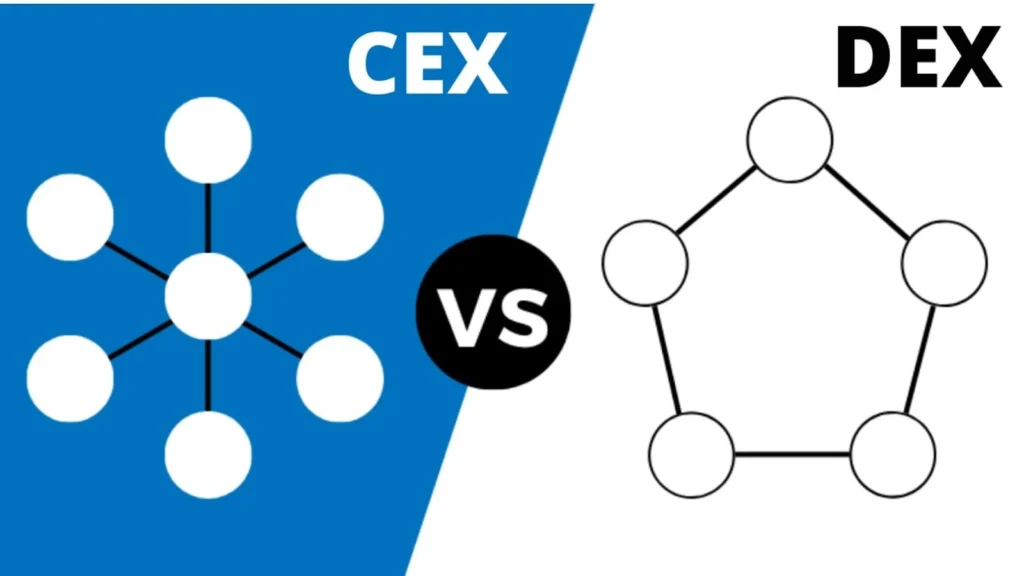
What Is a Centralized Cryptocurrency Exchange (CEX)?
A centralized crypto exchange is managed by a third party, observing and smoothing transactions and securing assets. The exchange supplies the needed infrastructure for market participants to conduct transactions. These transactions are mostly resolved off-chain on a centralized server the exchange operates.
Furthermore, centralized exchanges are generally governed by financial authorities and further have to operate under KYC and AML regulations to make sure their operations are legal. Crypto exchanges are exchanges that enable users to trade one cryptocurrency for another.
Centralised exchanges (CEX) are crypto exchanges that act as negotiators between buyers and sellers. They are called centralised because an agency with centralised decision-making power operates them. Before trading on CEX, a user must sign up and verify their account. If they are crypto holders, they can deposit to an exchange wallet which approves their account for trading. If not, traders can use fiat on-ramps to buy cryptocurrency with credit cards, bank transfers, and other means.
Advantages of a CEX
Right now, more than 75% of trading volume is working through CEX due to the ease of availability, security and order management, making them a more tough choice for organizations with high volume requirements. Benefits of CEXs are:
- Fiat Support: Provide traders ways to buy cryptocurrencies with local fiat currencies favor off-ramps to fiat.
- High Liquidity and Volume: Centralised exchanges have more liquid markets and provide organizations an attractive setting for their trades.
- Wide Variety of Supported Assets and Instruments: Centralised exchanges, as the authority proves transactions on their exchange, can encourage several cryptocurrencies , making it easier to trade cross currencies.
- User Experience and Support: Offer users support containing automatic interfaces that help traders with their questions.
Disadvantages of a CEX
Regardless, the advantages above, centralised exchange value also stands on the physical location of traders. Other disadvantages are:
- Requires Trust: When users deposit into centralised exchanges, they give up responsibility of their cryptocurrencies, removing the ability of traders to maintain utmost control of their assets.
- Single Point of Failure: Like other centralised platforms, centralised exchanges are an appealing target for hackers. Occasionally, regardless of best efforts, CEXs get hacked.
- Lack of Transparency: Money moving through centralised exchanges isn’t fully transparent to the public. Occasionally, when withdrawing users will not receive their transaction hash until receiving their transfer.
What Is a Decentralized Cryptocurrency Exchange (DEX)?
A decentralized cryptocurrency exchange is not run by a central authority but runs on a system of smart contracts that permits the exchange to function without centralized mistakes. This makes decentralized exchanges without a third person, meaning anyone is free to join without needing permission from the exchange. Thus, decentralized exchanges have no KYC or AML regulation.
Decentralized exchanges also operate on chains and have a different system for matching and settling trades. Instead of trading against other market members your trades are matched by an automated market system.
Advantages of a DEX
There are most of the advantages DEXs offer with their original model of simplified trading without negotiators.
- Non-Custodial
On the DEX platform, users are in control of their funds all the time. They pair a DEX with their crypto wallet and any transaction has to be signed and confirmed by the user before it’s executed. This means owners never give up custody, which line up with the idea of crypto self-superemacy.
- Permissionless
Users with an internet connection can access DEX. They do not distinguish by trader location.
- Transparency
While on DEX, traders can inspect all transactions. This provides a whole new level of awareness into a tokens trading history and methods to measure success.
- Censorship Resistance
With decentralised exchange protocols are censorship resistant.
Disadvantages of a DEX
DEX trading volumes line behind those of centralised exchanges. That’s the reason they come with a set of disadvantages that donate to lower adoption.
- Temporary Loss
While the ideal is for tokens in pools to finally trade in tandem with overall market price, more often than not, temporary loss can become permanent loss. Hence, liquidity offers disincentivised from installing their capital through DEX, decreasing overall liquidity.
- User Experience
The procedures for using decentralised exchanges can be less instinctive than those people who are used to from TradFi. Depending on the underlying blockchain, trades may prolong to execute and can be high priced, further contributing to friction in user passage.
- Token Support restricted
Since DEXs are built on-chain, they are restricted to offering support for tokens that are native to the chain they operate on.
- Hacks and Bugs
These DEXs are as secure as their code. If the code is poorly written or contains errors, they can be exploited.
Key Differences Between CEX And DEX
| Key aspects | CEX | DEX |
| Control of the system | Operated by centralized authorities e.g CEO, government etc. | There is no central authority.Operate on blockchains and smart contracts. |
| Custody of your assets | Custodial means the exchange holds your assets. | Non-custodial means users can control their assets. |
| Trading fee | Higher trading fee due to added services like customer support and fiat conversion. | Low platform fees. |
| Liquidity | High liquidity with fast execution of trades and minimal price impact. | Relies on liquidity pools, which can lead to lower liquidity and slippage for large trades. |
| Security | Vulnerable to hacking due to centralized structure but often includes insurance and customer support. | Safer from large-scale hacks but prone to smart contract vulnerabilities and user errors |
| Convenience | User-friendly interfaces with fiat-to-crypto options and additional features. | Requires a crypto wallet and basic understanding of blockchain. |
| Privacy | Limited privacy, as user data and identity may be required (KYC). | High privacy; no KYC or identity verification needed. |
Conclusion
Centralized vs decentralized exchanges have long been discussed in crypto. Both provide different things, and it’s just not easy to say that the first is simply better than the other. When selecting between centralized and decentralized crypto exchanges, analyze the benefits and risks of both.
Centralized exchanges provide high liquidity and user-friendly interfaces but uncover you to security threats and privacy matters. Decentralized exchanges offer increased safety and control over private keys but confront challenges like lower liquidity and smart contract vulnerabilities.
FAQs
Are decentralized exchanges safer than centralized exchanges?
Decentralized exchanges are simply secure in terms of avoiding platform-wide hacks because there’s no central storehouse of funds. However, they need users to manage their own private keys, which present personal responsibility for security.
Can I use fiat currency on a decentralized exchange?
No, decentralized exchanges or DEX do not support fiat currencies. You’ll be required to hold cryptocurrency before using a DEX. CEXs, on the other hand,permits you to buy crypto with fiat using bank transfers or credit cards.